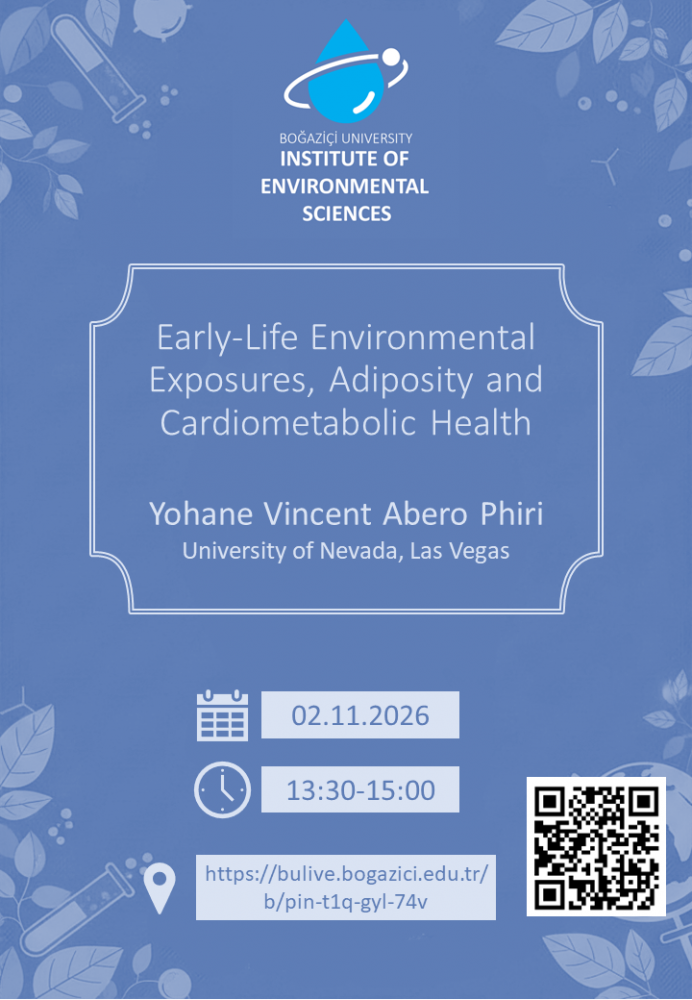
IESc Seminar Series: Early-Life Environmental Exposures, Adiposity and Cardiometabolic Health by Yohane Vincent Abero Phiri
Institute of Environmental Sciences Seminar Series
“Early-Life Environmental Exposures, Adiposity and Cardiometabolic Health”
by Yohane Vincent Abero Phiri
University of Nevada, Las Vegas
We cordially invite you to our seminar “Early-Life Environmental Exposures, Adiposity and Cardiometabolic Health" to be held by Yohane Vincent Abero Phiri, University of Nevada, Las Vegas
When: 2 November, 2026, Monday, 13:30-15:00
Where: Online at https://bulive.bogazici.edu.tr/b/pin-t1q-gyl-74v
Contact: pinar.ertor@bogazici.edu.tr for any questions.
Abstract:
Early-life exposures to environmental chemicals, air pollution, and indoor allergens shape health trajectories across childhood, adulthood, and across generations. By integrating exposure assessment, biomonitoring, large administrative datasets, longitudinal birth cohorts, and advanced mixture analyses, we identify modifiable disease determinants and their underlying biological mechanisms. In a recent publication, we examined how organophosphate esters (OPEs), widely used as flame retardants and plasticizers, may disrupt metabolic processes involved in energy balance, adiposity, and cardiometabolic health. We investigated associations between gestational OPE exposure and childhood adiposity among 283 mother-child dyads from the pan-Canadian Maternal-Infant Research on Environmental Chemicals (MIREC) cohort. Urinary concentrations of five OPE metabolites were quantified at 6-13 and 16-21 weeks of gestation, and seven adiposity indicators were assessed during childhood visits at ages 7-11 years. We applied adjusted linear and modified Poisson regression, quantile g-computation to evaluate joint mixture effects, and generalized additive models to detect non-linear exposure-response relationships. Associations varied by specific metabolite and gestational window: early-pregnancy bis(1-chloro-2-propyl) phosphate (BCIPP) was associated with an elevated risk of overweight or obesity (adjusted risk ratio=1.05; 95% CI: 1.02, 1.08) and greater body fat percentage, while di-n-butyl phosphate (DNBP) was associated with higher waist-to-height ratio Z-scores. Second-trimester BCIPP remained significantly associated with overweight or obesity risk. Although the overall mixture effect was null, BCIPP and DNBP contributed the largest weights to joint effects. Several exposure-response relationships were non-linear, and sex-stratified models suggested potential female-specific susceptibility patterns that warrant further exploration. Together, these findings indicate that gestational OPE exposure may contribute to childhood adiposity, though replication in larger and more diverse cohorts is necessary.
Short bio:
 Dr. Phiri is an Environmental Health Epidemiologist and currently a Research Scholar in the Department of Epidemiology and Biostatistics at the University of Nevada, Las Vegas, where he leads research on gestational organophosphate ester (OPE) exposure and childhood adiposity under an U.S. National Institute Health NIEHS-funded project. His research examines how early-life exposures, including ambient air pollution, indoor air quality, and chemical mixtures, shape pediatric cardiometabolic and allergic disease trajectories. Having completed prior postdoctoral training at the University at Buffalo focusing on air pollution and perinatal outcomes, he earned his Ph.D. in Epidemiology and Environmental Health from Taipei Medical University with research centered on the Longitudinal Examination Across Prenatal and Postpartum Health in Taiwan (LEAPP-HIT) birth cohort. He brings advanced methodological expertise in longitudinal modeling, mixture analyses, and large-scale datasets such as Maternal-Infant Research on Environmental Chemicals (MIREC), National Health and Nutrition Examination Survey (NHANES), and U.S. Medicare. He has published widely in peer-reviewed journals including Environmental Research, Scientific Reports, and Health Research Policy and Systems, serves as an editor for BMC Public Health, maintains international research collaborations spanning the United States, Canada, Taiwan, Indonesia, Türkiye, and sub-Saharan Africa, and remains deeply committed to translating environmental health research into evidence-based public health policy while mentoring the next generation of researchers.