IESc Seminar Series: From Contaminant Fate to Ecosystem Responses: Emerging Pollutants in the Soil-Plant System by Lama Ramadan
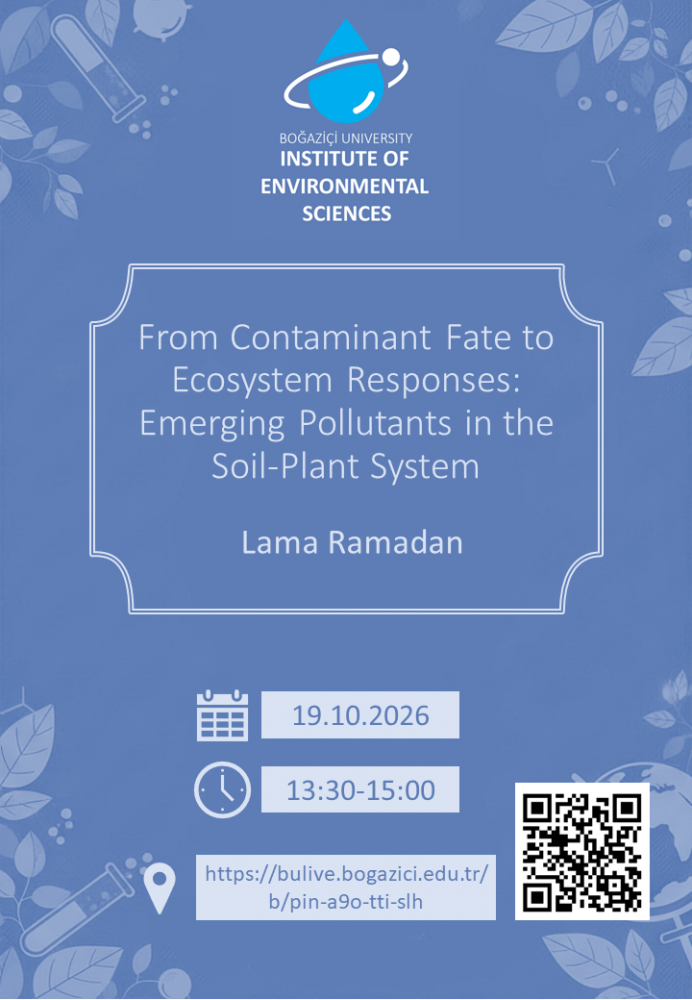
Institute of Environmental Sciences Seminar Series
“From Contaminant Fate to Ecosystem Responses: Emerging Pollutants in the Soil-Plant System”
by Lama Ramadan
We cordially invite you to our seminar “From Contaminant Fate to Ecosystem Responses: Emerging Pollutants in the Soil-Plant System” to be held by Lama Ramadan, from Northwest A&F University,
When: 19 October, 2026, Monday, 13:30-15:00
Where: Online at https://bulive.bogazici.edu.tr/b/pin-a9o-tti-slh
Contact: pinar.ertor@bogazici.edu.tr for any questions.
Abstract:
Emerging contaminants (ECs) enter aquatic and terrestrial environments where multiple stressors, including climate change and microplastic pollution, can alter their transformation, mobility, and bioavailability, with consequences for environmental exposure and ecosystem functioning. Understanding these effects requires moving beyond individual ECs and isolated environmental conditions to elucidate how chemical and biological processes respond to interacting stressors.
In this seminar, I will introduce how multiple environmental stressors, including climate change and microplastic pollution, can influence the fate and transformation of emerging contaminants (ECs) across aquatic and terrestrial environments, with a particular focus on the combined effects of ECs and microplastics (MPs) in soil-plant systems. By integrating chemical measurements using liquid chromatography-tandem mass spectrometry (LC-MS/MS) with analyses of soil and rhizosphere microbial communities, carbon cycling, and plant responses, this research links contaminant fate with biological processes and ecosystem functioning in soil-plant systems.
Short bio:
 Dr. Lama Ramadan is an environmental researcher with a PhD in Environmental Engineering whose work investigates how emerging contaminants and interacting environmental stressors shape contaminant fate and ecosystem functioning. Her research integrates analytical environmental chemistry, including LC-MS/MS, with experimental approaches and multivariate statistical analysis to examine contaminant transformation in aquatic and terrestrial environment, soil-plant transfer, microbial community responses, and plant-microbe interactions. Her interests extend to the implications of these processes for carbon and nutrient cycling, ecosystem resilience, and sustainable environmental mitigation. She has conducted interdisciplinary research in Türkiye and the Netherlands, with doctoral research spanning Gebze Technical University, the Netherlands Institute of Ecology, and Wageningen University & Research. Her research aims to connect chemical exposure with biological and ecosystem-level responses to advance understanding of environmental risks and inform strategies for reducing contaminant impacts and supporting ecosystem functioning under changing environmental conditions.